

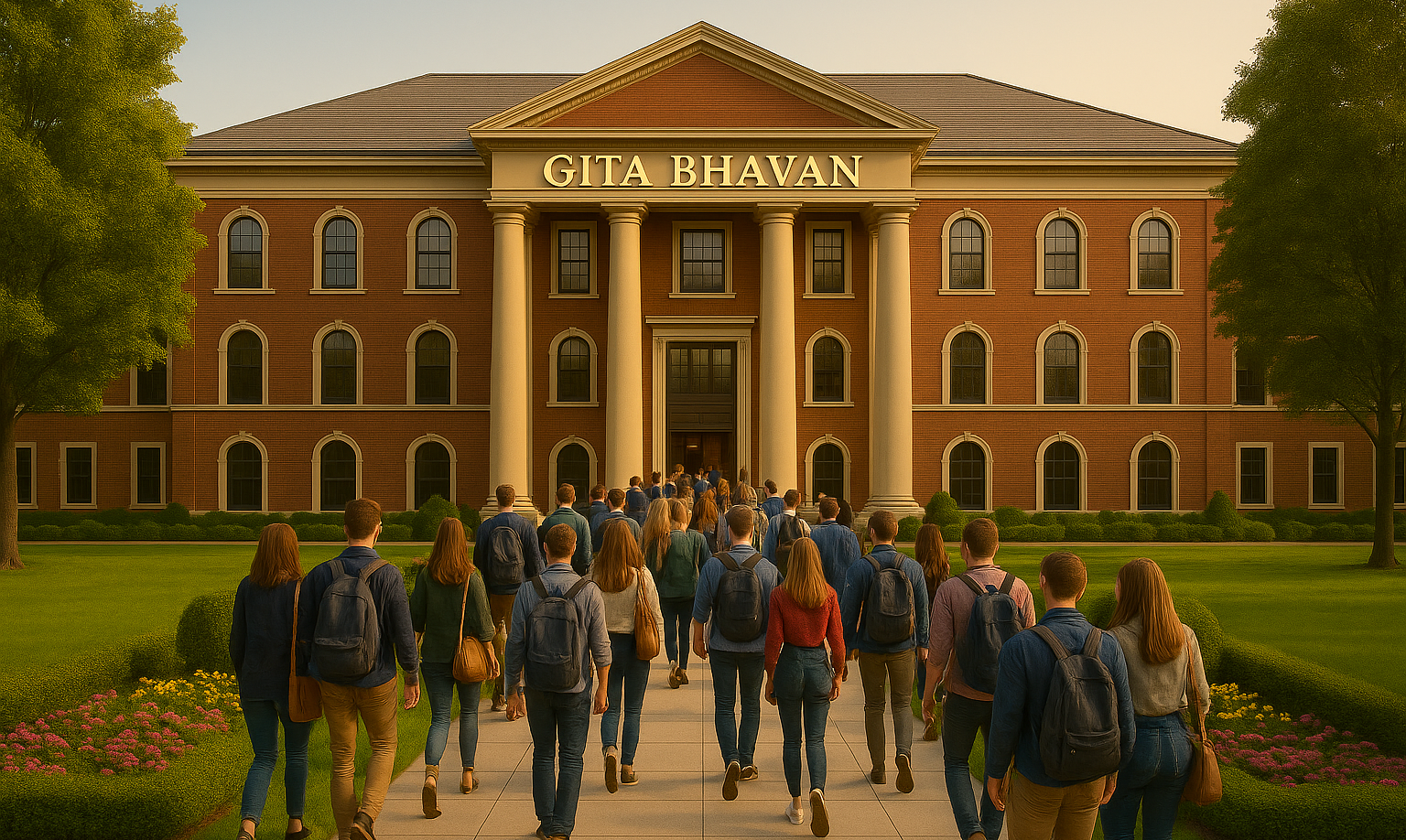
108 Gita Bhavans Worldwide
Introduction
Following the successful establishment and one-year operation of the International School for Bhagavad Gita at Shankarpally, Hyderabad—scheduled for commissioning by December 2026—we now present a visionary global expansion that will first reach Pan-India and then extend into key international destinations. This new phase introduces two high-impact experiential programs designed to democratise spiritual clarity, emotional resilience, and an Advaita-based understanding worldwide.
Program 2: Karma Yoga for International Tourists
This program offers a 3-hour transformative spiritual immersion (extended to 3 days at our Hyderabad campus) at no cost. It unveils the purpose of life, the nature of consciousness, and the science of inner balance through the Advaita perspective of the Bhagavad Gita. Sessions will be held twice daily at every Gita Bhavan—1,000 participants before lunch and 1,000 after lunch—ensuring deep, accessible learning for global visitors.
Program 6: One-Day Karma Yoga Retreat for Urban White-Collar Workers
Modern professionals carry silent emotional burdens—stress, burnout, loneliness, pressure, and disconnection. This paid retreat becomes a practical and therapeutic space for emotional detox, mental clarity, and spiritual recalibration. It equips participants to regain inner balance amidst relentless responsibilities at work and home, allowing them to leave with renewed calmness, sharper insight, and deeper self-understanding.
Gita Bhavan: The Infrastructure of Impact
A Gita Bhavan is not a temple or a lecture hall; it is a transformative spiritual campus where wisdom is not preached but experienced. These centres serve as sanctuaries for global citizens, integrating silence, science, and Advaita inquiry to accelerate inner evolution.
Each Gita Bhavan will be built on 5 acres, featuring:
- A 1,000-capacity auditorium
- Accommodation for staff and teachers: 10 One-BHK units, 10 Two-BHK units, 5 Three-BHK units, 10 Standard Rooms, 10 Executive Rooms
- A sattvic canteen, hygienic restrooms for large gatherings
- Parking for 250 vehicles
The construction cost (excluding land) is estimated at ₹25 crores per centre.
Strategic Rollout Plan (2029–2035)
Phase 1: India (2029–2030)
Eight Gita Bhavans will be established in India’s most popular spiritual and tourist destinations, such as Varanasi, Rameswaram, Ujjain, Tirupati, Haridwar, and three other high-footfall cities. Partnerships will be cultivated with: the Ministry of Tourism (State & Central), the Ministry of Higher Education, the PM CARES Fund, the CSR wings of leading corporations, and Temple Boards and Trusts.
Phase 2: Global Expansion (2031–2035)
During this phase, 100 Gita Bhavans will be launched across the world’s most visited cities and spiritual hubs—such as Bali, Kyoto, Jerusalem, San Francisco, London, Singapore, Dubai, Sydney, Toronto, New York, and other major cultural destinations. Each centre will serve 2,000 participants every day, offered through two structured 3-hour sessions of 1,000 participants each.
When all 108 centres (8 in India + 100 worldwide) become operational, the combined annual outreach reaches an extraordinary scale:108 centres × 2,000 people/day × 300 days/year = 6.48 crore people per year.
This translates to 64.8 million lives annually impacted by direct exposure to Advaita wisdom.
To strengthen the global foundation of this initiative, 100 Fortune 500 companies will be invited to sponsor one Gita Bhavan each as part of their long-term CSR commitment to international peace, emotional well-being, and intercultural harmony.
The Vision: Touching 50% of Humanity by 2050 and 75% by 2100
The power of Gita Bhavans does not lie merely in footfall but in the exponential ripple effect of transformed individuals who carry forward the wisdom into their families, workplaces, and social ecosystems.
Each year, nearly 6.6 crore people (66 million individuals) absorb, internalise, and naturally share these teachings. Even if each attendee influences only a small circle of relatives, colleagues, and friends, the multiplier effect becomes astonishing.
With steady expansion and consistent operation:
- By 2050, at least 50% of humanity can be touched by the principles of Karma Yoga and Sankhya Yoga in the Advaita Perspective.
- By 2100, the influence of Gita Bhavans can reach 75% of the world’s population, becoming a defining force in shaping a peaceful, rational, and unified global civilisation.
Even if this projection faces a delay of 10–20 years, it remains entirely acceptable, especially when we consider that humanity has spent thousands of years cultivating ignorance—ignorance that must now be dissolved with clarity, compassion, and wisdom.
The Inner Revolution: What Participants Take Home
Gita Bhavan programs are not passive lectures; they are immersive experiences that restructure one’s worldview, emotional architecture, and inner identity.
Participants leave with:
- Clear, logical answers to life’s most profound questions
- A direct experience of divinity, not a conceptual belief
- Consistent equanimity amid success and failure
- Reduced emotional reactivity and greater maturity
- A healthier, more compassionate relationship with self and others
- Firm grounding in self-responsibility instead of victimhood
- A natural inclination toward service and global citizenship
- Renewed reverence for nature and cosmic intelligence
- A shift from “God outside” to “God experienced within”
They emerge as individuals who think with clarity, feel with balance, and act with purpose.
WHY PEOPLE COME TO GITA BHAVANS
The Universal Questions of Humanity
1. Questions About Birth, Inequality, and Justice
- Why are some born rich while others are born into starvation?
- Why are some children born healthy, but others with deformities or incurable diseases?
- Why are some born into loving families while others are abandoned or abused?
- If God decides our birth, where is the fairness in such extreme inequality?
- Why are some born in war zones and others in peaceful countries?
- Why do natural disasters kill thousands who have done nothing wrong?
2. Questions About Religious Assignment at Birth
- If Jesus is the only way, why are billions born in Hindu, Muslim, Buddhist, Sikh, Jewish, or atheist households?
- If Allah alone must be worshipped, why does He grant success to non-believers and idol worshippers?
- If salvation depends on faith, why does God place most people where that faith is not taught?
- Why should anyone be punished for the religion they were born into?
- Why would God send prophets late in human history — after billions already lived and died without “the message”?
3. Questions About Humanity Before Recent Religions
- What happened to all the humans who lived for millions of years before prophets appeared?
- Did they all go to hell because they had no way to know any “true religion”?
- Why should eternal destiny depend on the accident of being born after certain scriptures were written?
4. Questions About Origin and Destiny of the Soul
- Where was I before I was born?
- If my soul had a beginning, will it also have an end?
- If I existed with God earlier, why was I sent to Earth at all?
- Why would God create souls, label them sinners, then make return-to-God dependent on complex scriptures?
- Why create beings who must struggle endlessly to understand Him?
5. Questions About God’s Silence and Invisibility
- Why doesn’t God speak directly if He wants humanity to know the truth?
- Why not appear once on global television and end all confusion?
- Why remain silent while people kill each other in His name?
- Why allow contradictory scriptures if truth is one?
- Why allow innocent children to suffer without explanation?
6. Questions About Contradictions in Scriptures
- Why do some scriptures justify slavery, polygamy, stoning, and harsh punishments?
- Why call sex a sin but give humans powerful sexual instincts?
- Why create foreskin and command it to be painfully cut later?
- Why declare doubt to be blasphemy when curiosity is natural?
- Why is asking honest questions considered disrespectful?
7. Questions About Divine Ego and Worship
- If God blesses us based on deeds, why should we flatter or praise Him?
- Why would God demand constant worship like an insecure lover?
- Why take offerings from the poor and punish those who don’t worship “properly”?
- Why is God portrayed as jealous or angry in some texts?
8. Questions About Prayer, Miracles, and Destiny
- If everything is God’s plan, what is the purpose of prayer?
- If someone recovers, people say, “God healed you.”
- If they die, people say, “God took them away.”
- Is this circular logic helpful or truthful?
- Why do miracles happen only for a few while millions pray in vain?
9. Questions About Science vs Religious Timelines
- If Adam and Eve were born in 4000 BCE, how do we explain fossils millions of years old?
- If Earth is only a few thousand years old, why do scientists date it at 4.54 billion years?
- What about dinosaurs, early humans, and prehistoric civilisations?
- Why is geological, astronomical, and evolutionary evidence ignored by some religions?
10. Questions About Creation and Divine Purpose
- Why did God create anything at all if He was perfect and complete?
- Why create suffering, desire, ignorance, and then punish people for them?
- Why create a universe full of struggle if He is all-compassionate?
- If God is unchanging, why create? Creation implies change.
- Why create beings who can make mistakes and then punish them eternally?
- Why create Hell at all?
11. Questions About Human Limitations
- Why do humans struggle to study, remember, and focus?
- Why is basic education a nightmare for many children?
- If birds migrate thousands of miles with perfect memory, why can’t humans remember simple formulas?
- If bees build perfect hexagons with no schooling, why are humans so cognitively inconsistent?
- Why create humans with unstable emotions, depression, anxiety, fear, and insecurity?
12. Questions About Love, Relationships, and Marriage
- Why does love fade after marriage?
- Why does affection turn into ego, boredom, or conflict?
- If God created humans, why not hardwire loyalty and emotional stability?
- Swans and penguins mate for life without reading scriptures—why aren’t humans designed with the same natural bonding strength?
13. Questions About Death and the Afterlife
- Why is death so frightening?
- Why does no religion give clear, unanimous answers about the afterlife?
- Why contradicting descriptions of heaven and hell?
- Why eternal punishment for temporary human mistakes?
- Why do near-death experiences differ across cultures?
14. Questions About Moral Accountability
- If everything happens by God’s will, why punish humans?
- If humans are created weak, emotional, and confused, why hold them to perfect moral standards?
- Why blame humans for instincts God Himself implanted?
- Why give free will to beings who barely understand themselves?
15. Questions About Free Will & Karma
- If karma decides everything, where is freedom?
- If free will decides everything, why are circumstances so unequal from birth?
- How can destiny and free will both be true simultaneously?
- Why do good people suffer more sometimes?
- Why do immoral people often succeed?
16. Questions About Religious Conflict
- Why do people fight over which book is true?
- If God is one, why create so many contradictory religions?
- Why are billions killed in His name?
- Why are children indoctrinated before they can think?
- Why should eternal truth depend on regional politics and ancient wars?
17. Questions About Divine Fairness
- Why place humans in conditions where wrong choices are almost guaranteed?
- Why make truth so difficult to find and falsehood so attractive?
- Why allow mentally ill people to be condemned morally?
- Why design a world where survival often forces moral compromise?
18. Questions About Human Identity
- Who am I really?
- Am I my body, my mind, my personality, or something else?
- What happens to “me” after death?
- What is the purpose of being born again and again?
- Why do I feel separate from nature and others?
19. Questions About the Nature of God
- Is God a person, a force, a field, or pure consciousness?
- Why does God seem loving in some texts and violent in others?
- Why does God allow injustice?
- Does God favour some people or nations?
- If God is omnipresent, why do we not feel Him?
20. Questions About Truth Itself
- Why is truth different in different religions?
- Why do scriptures contradict science?
- How do we know which path is real?
- Why is doubt condemned when doubt is the beginning of wisdom?
- If God wanted us to know Him, why leave humanity in confusion for thousands of years?
21. OTHER GENERAL QUESTIONS
- If morality influences destiny, why are a person’s moral choices shaped mainly through their upbringing, trauma, hormones, education, and environment—factors they never chose?
- If life is a test, why erase memories of past lives? How can anyone learn from their mistakes if they cannot remember them?
- If everything is part of God’s plan, how can humans be held accountable for executing a plan they never authored?
- If God wants humans to know Him, why is His presence ambiguous, inconsistent, and culturally variable?
- Why do major religions share strikingly similar stories—floods, virgin births, prophets, miracles? Did they borrow from one another, or is the human mind repeating patterns?
- In a universe with billions of galaxies and trillions of planets, why would human belief on a tiny planet determine eternal destiny?
- If people worship mainly to avoid hell or gain heaven, is that devotion sincere or simply transactional?
- If salvation depends on scriptures, why rely on texts that passed through translation, copying, editing, political councils, and human error?
- If God wanted one true religion, why allow thousands of conflicting paths? Why not protect only the correct one and remove the rest?
- Why create mental illnesses—depression, anxiety, schizophrenia—that impair judgment, and then morally judge the individual?
- During near-death experiences, people from different cultures see different divine figures. Does God appear differently to each person, or does the mind produce these experiences?
- If enlightenment liberates, why were enlightened sages concentrated in only certain regions like India, Greece, and China? Why favour some geographies?
- If belief decides destiny, how is it fair that children are conditioned into a religion before they develop reasoning?
- Why did God remain silent during the worst human atrocities—holocausts, genocides, slavery, inquisitions, caste violence, world wars?
- If God designed every human flaw—anger, jealousy, fear, greed—why blame the flawed being instead of the designer?
- Why would a compassionate God create a system where finite mistakes are punished with infinite, eternal suffering?
- If enlightenment is the goal, why design a system that requires thousands of births rather than offering a single, universal revelation?
- If God personally designs humans, why does biological evolution show random mutations, extinctions, and natural selection instead of deliberate intention?
- How can humans be obligated to follow a divine covenant or command when they never signed or consciously agreed to it?
- If God loves all equally, why do only a tiny fraction of people ever attain enlightenment while the rest remain trapped in confusion and ignorance?
Why do all these questions lead people to Gita Bhavans
Because Gita Bhavans do not silence questions — they illuminate them.
They offer:
- clear logic,
- experiential understanding,
- non-dual answers,
- universal spirituality,
- No fear, no dogma, no blind belief.
They help people see God not as a separate being, but as the Consciousness within.
That is why people come. They enter as petty human beings, carrying all the attributes that create the illusion of division and separateness, as described in Gita 18.21. Some even walk in as atheists, as described in Gita 18.22. Yet they walk out as divine beings — none other than the one, indivisible Universal Consciousness, as declared in Gita 18.20.